How I observe and observational resources, Mel Bartels
It's changed so much and yet so little over the many years
When I first started as a kid with a Tasco reflector my references were the Edmund Sky Guide, full of good information, and Howard's The Telescope Handbook and Star Atlas. Finding an object could really try my patience. Sometimes it would take me an hour to find an object using a cardboard peephole finder. As I bought or copied atlases, I would lay the atlas out on the table, select an object and figure out how to star hop to it using an 8x50 finder.
Things have changed. Today I use a variety of telescopes, eyepieces, filters, references, atlases and finders. I'll study an object ahead of time using the internet, then under the stars, my PiFinder or SkySolve plate solving camera will point the way. Finding the object is but a prelude. I observe by making a series of sketches.
While telescopes and finders have dramatically changed, my essential experience has not: finding a faint object then taking the time to truly see it.
How I decide on what to observe
- Get a book, read about an object, go find it on the next clear night, make observing notes or a drawing or just enjoy
- Download a reference, read about an object, go find it, make observing notes or a drawing or just enjoy
- Read a magazine article, go find the object(s), make observing notes or a drawing or just enjoy
- Come across an interesting object via Cloudy Nights, research it, observe and draw or just enjoy
- Find objects nearby where you are pointed via SkySafari, Stellarium or similar, observe and enjoy
- Find and observe an object you've seen before and know how to get to
- Find an interesting deep digital image and draw what I see
- Move the scope around, find something interesting, look it up in SkySafari
Observing approaches
- Surfing: stop by an object, take in the view, move on. This is fun and shows the variety of what's up there. Particularly useful when comparing globular clusters, for example, for shape, concentration and brightness. Hard to avoid when in a group setting where observers are calling out objects left and right.
- Deep dive: observe by drawing. Takes an hour or two per object with a followup the next night.
How I find objects
- Dead reckoning
- Star hopping
- Plate-solving finder (PiFinder works on Android and Windows for SkySafari and Stellarium)
- Get a bud to find it for you
Online resources
- Astronomical League observing tools illustrating how to find a few objects
https://www.astroleague.org/night-sky-observing-tools/
- Astronomical League observing programs
https://www.astroleague.org/observing-program-division/
- Atlas of the Andromeda Galaxy, 39 charts
https://ned.ipac.caltech.edu/level5/ANDROMEDA_Atlas/frames.html
- Big, Bold, Bright, and Beautiful, An observing list by Jerry Oltion
https://www.jerryoltion.com/BBBB_2025-10-25.pdf
- Deep-sky binocular catalog, double stars, deep sky list
https://deepsky.vdsastro.de/en/project-deep-sky-with-binoculars.php
- Faint Fuzzies downloadable observing guides for advanced observers (pages combine a naked-eye chart, Telrad overlay, detailed finder chart, DSS image, and actual visual observing notes/eyepiece renditions)
https://faintfuzzies.com/DownloadableObservingGuides2.html
- Finder charts Messier, Caldwell
https://sherwood-observatory.org.uk/astronomy/finder-charts/
- Halton Arp's Atlas of Percuilar Galaxies
https://ned.ipac.caltech.edu/level5/Arp/paper.pdf
- Harold Cowin's selected catalogs (NGC/IC, et al)
http://haroldcorwin.net/
- Jim's Cosmos with charts for Messier objects, Caldwell objects and Herschel 400 objects along with constellation charts
https://www.robhawley.net/mm/
- Messier Field Guide by Bhavesh Parekh
https://pdxastronomy.com/
- Messier marathon finder charts and guide by Rob Hawley
https://www.robhawley.net/mm/
- Messier objects finder charts
https://freestarcharts.com/index.php/messier-catalogue
- Monthly evening sky charts, download
https://skymaps.com/downloads.html
- Observing tools; needs subscription
https://skyandtelescope.org/
- Scott Harrington's 250 best objects for binoculars and the naked-eye
https://drive.google.com/file/d/1qvu4oJitOL0lbJ9lr8sQWpN4ZGNZP6M1/view
- Stargazing buddy's 161 object catalog
https://stargazingbuddy.com/
- Steve Gottleib's deep sky observing reference comprehensive
https://deepskygottlieb.com/library/
- Reiner Vogel's catalogs including Wolf-Rayet nebulae, exotic nebulae, Sharpless regions, young stellar objects, planetary nebulae, Abell planetaries and Hickson groups
https://reinervogel.net/index_e.html
- Web Deep-Sky Society downloads including galaxy trios, the Bedford Catalog, brightest planetary nebulae, objects of the week, Clear Sky Observing Guides, and more
https://www.webbdeepsky.com/publications/free/
- Wide field vistas by Robert Asumendi
https://drive.google.com/file/d/1DasXm1WUOnsKA-IhgAqcT3UXUHCKuEdG/view?usp=sharing
Book resources
- A Field Guide to the Stars and Planets by Menzel and Pasachoff (class pocket sized field guide)
- Annals of the Deep Sky, Vol 1-13-, by Kanipe (ongoing series, like Burnham's but up to date with a great deal of astrophysics, not as inspiring as Burnham's though)
- Atlas of the Messier Objects by Stoyan, Binnewies, Friedrich and Schroeder (very thorough)
- Celestial Handbook Vol 1, 2 and 3 by Burnham (the classic)
- Deep Sky Objects by Levy (small intro book)
- Deep Sky Companions: Hidden Treasures by O'Meara (interesting, sketches, stories)
- Deep-Sky Wonders by French (easy read and informative)
- Herschel 400 Observing Guide by O'Meara (serious observing, thorough)
- Interstellarum Deep Sky Guide by Stoyan and Glahn (comprehensive)
- Observing Handbook by Skiff & Luginbuhl (old but useful)
- Star Clusters by Archinald Hynes (deep dive)
- The Year-Round Messier Marathon Field Guide by Pennington (all you want to know about planning and executing the Messier Marathon)
- The Messier Album by Mallas and Kreimer (classic, drawings)
- The Great Atlas of the Stars by Brunier (more of a table top atlas)
- The Arp Atlas of Peculiar Galaxies by Kanipe and Webb (thorough, all the Arps)
- The Night Sky Observer's Guide, Vol 1, 2 and 3 by Kepple (3 volumes: a great deal of info, a reference)
- Turn Left at Orion by Consolmagno and Davis (classic beginner's intro but a good read for experienced observers too)
- Visual Observations of Planetary Nebulae by Wallace (very thorough and a deep dive)
- Webb Society Deep-Sky Observer's Handbook, 8 volumes (came after Burnham's, deeper visual oriented)
- A Portfolio of Lunar Drawings by Hill
- Lunar Cognita, Vol 1, 2 and 3 by Garfinkle
- The Modern Moon by Wood
Observing handbooks
There are many, but the annual Canadian Observer's Handbook is quite comprenesive.
Charts
There are so many printed charts, some quite beautiful. Here are the major online charts and telescope control apps for the desktop and phone that I use or are aware of. There are many more out there.
Runs on laptop or phone, interactive
- Astrohopper, a web based app for the phone
https://artyom-beilis.github.io/astrohopper.html
- Cartes du Ciel, free software to draw charts, for Windows, Linux, macOS
https://www.ap-i.net/skychart/en/start
- KStars for Windows, macOS, Linux, astronomy software
https://kstars.kde.org/
- A Simple Guide to Backyard Astronomy using Binoculars or a Small Telescope, 55 pages, for novice and light polluted skies, includes Messier Objects for Telrad finders
https://www.carolrpt.com/astroguide.htm
- SkySafari for iOS and Android (can run an Android simulator on a Windows machine; Linux not supported)
https://skysafariastronomy.com/products/skysafari-8-pro
- Star Walk 2 for Android and iOS, beginner friendly, beautiful
https://starwalk.space/en
- Starry Night for Mac/Windows
https://starrynight.com/starry-night-8-professional-astronomy-telescope-control-software.html
- Stellarium for the Web, macOS, Linux, Windows, iOS and Android
https://stellarium-web.org/
- World Wide Telescope for browsers
https://worldwidetelescope.org/webclient/
Downloadable, passive, displays on laptop or phone
- 160 best deep sky object charts by Chris Buaya
https://drive.google.com/file/d/10cYRY_5vxUCS7GbEOTER9ygDxZO3yM_8/view?usp=sharing
- Atlas of Galactic Nebulae by Vehrenberg and Neckel, 3 volume reference set, 1547 objects, 1990, rare, out of print, some errors but valuable today
https://drive.google.com/drive/folders/1zdzA5uYeRxZ5fnQ2qnFFszhf-p3jvyR0?usp=sharing
- Atlas of the Sky, French and English (reminiscent of the Cambridge Atlas) by Claude Duplessis
https://www.claudeduplessis.com/Astro/Anglo/atlas.html
- CzSky web based planetarium program-division/
https://www.czsky.eu/chart?fullscreen=true&ra=4.729908944&dec=-0.517616438&fsz=45
- Deep-Sky Hunter Star Atlas, printable deep sky atlas for serious observers with zoom charts
https://www.deepskywatch.com/deep-sky-hunter-atlas.html
- Edmund Mag 5 Star Atlas
https://drive.google.com/file/d/1O9n4Q_L1f7bZlqFdFmw8ppCVotnSxhMd/view?usp=sharing
- JR Torres' atlases including Triatlas, another deepsky atlas of 5800 one degree fields, a third PDF document listing the best 11000 deepsky objects, CNebulaX Project atlas (25 million stars) and visibility prediction software
https://www.uv.es/jrtorres/tools.html#Atlas2
- Mag 7 atlas by Andrew Johnson, color
https://dn710604.ca.archive.org/0/items/Mag_7_Star_Atlas/Mag_7_Star_Atlas.pdf
- MidnightKite 6 charts, constellation lines from H.A.Rey's "The Stars"
http://www.midnightkite.com/index.aspx
- Night Sky Maps by Olle Eriksson, 3 atlases of 10,20 and 30 charts of northern and southern sky
https://www.olle-eriksson.com/night-sky-maps/
- Pretty Deep Maps, a detailed all-sky astronomical atlas; massive hyperlinked atlas, 8GB. "Objects to mag 18, 6787 pdf charts, plot approximately 117k bright stars, 600 million field stars, 2.4 million galaxies, 277k variable stars, 110k multiple stars, 168k quasars, 8955 galaxy groups, 5250 galaxy clusters, 5004 dark nebulae, 2411 planetary nebulae, 1249 bright nebulae, 2167 open clusters, 159 reflection nebulae and 157 globular clusters. The celestial sphere is divided into 6787 charts, each covering 3 degrees of declination at a map scale of 11.74" per mm"
https://zenodo.org/records/3522809#.Xqxxbpl7lhE
- Toshimi Taki's mag 8.5 atlas
https://allans-stuff.com/takis-8-5-magnitude-star-atlas/
- Triatlas, Nearly 1 GB, hundreds of charts with many thousands of objects in A4 and A3 format
https://allans-stuff.com/triatlas/
Printed atlases
I used to collect printed atlases. I still have them. There are too many to list. Wil Tirion's SkyAtlas 2000 is among the most useful in the field.
https://dn760008.eu.archive.org/0/items/sky-atlas-2000.-0_202401/Sky%20Atlas%202000.%200.pdf
Deep Sky magazine
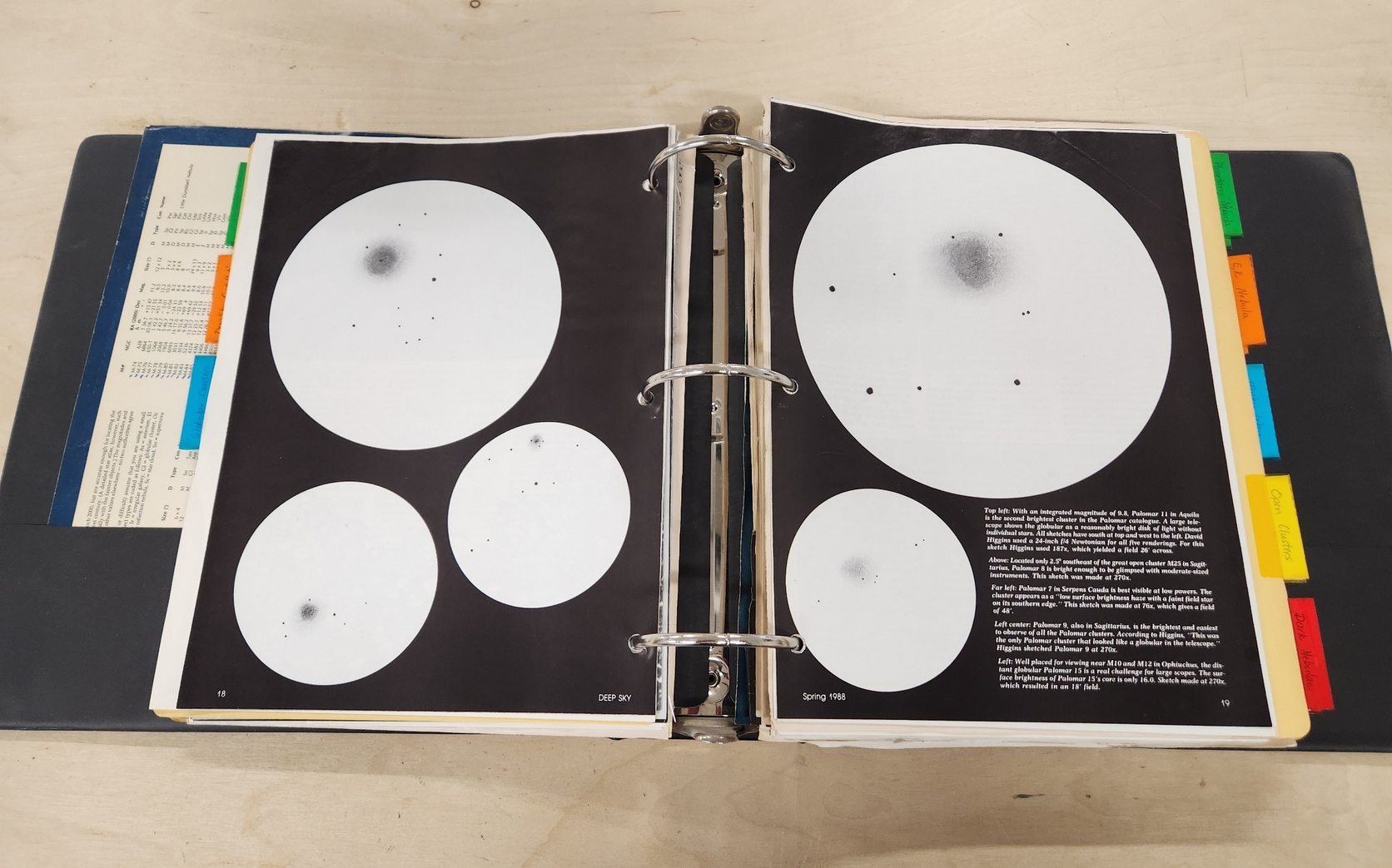
I cut out the articles and put them in an observing notebook organized by object type.
eod